 |
|
 |

NEW YORK CITY, MAY 23, 2002 --
Gaffco receives write-up in The Wall Street Journal (see
article below).

Playing it Safe
Edgy Companies, Executives Boost
Spending on Security
To Fight Danger Here, Abroad

by
Kris Maher
Up until recently,
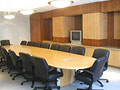
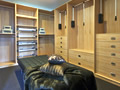
Gaffco, Inc. was known for installing the fancy woodworking, often
in cherry or mahogany, that adorns executive suites. But these
days the Mount Vernon, N.Y., company has a new growth business
bulletproofing boardrooms.
During a weekend,
Gaffco rips up office floors, walls and ceilings and installs
layers of armored steel and bullet-resistant fiberglass beneath
a surface of fine woodwork. On Monday, nobody is the wiser, except
the executives footing the bills.
In the past
three months, Gaffco has redone six boardrooms in Manhattan, mostly
for financial institutions, with costs ranging from $50,000 to
$250,000. The reinforced rooms, resembling the "panic room"
in the film of that name, typically are built to withstand an
armed assault from outside for as long as 30 minutes, time enough
for police or security to arrive. Gaffco says it also has paid
orders or approvals for 28 more rooms, as many as it built in
all of 2001.
Amid fresh
warning of more possible major terrorist attacks on the U.S. and
recent Federal Bureau of Investigation warnings that financial
institutions in the Northeast may be targeted, company managers
are growing edgy. Small wonder: As the public face of a corporation,
or a potential symbol of American capitalism, executives are ready
targets, not just for terrorists and kidnappers, security experts
say, but also for angry shareholders or pink-slipped employees.
Spending for
corporate protection has been rising steadily for decades, but
now security is taking on new urgency even for managers who were
more casual about the issue before. R.L. Oatman & Associates'
intense, seven-day course on executive protection used to draw
only security experts. Earlier this month the fully booked course,
which the Towson, Md., company has offered since 1994, had a fair
share of executives who aren't in security. The $3,150 program,
including lodging, meals, and training materials, including ammunition,
offers lessons on everything from how to avoid being kidnapped
to bomb detection.
"Based
on the present alerts and what is going on in the Middle East,
executives have become much more aware of their exposure to world
events," says Robert Oatman, company president.
Experts say
the current security boom initially was a reaction to Sept. 11.
Right after the attacks, Thomas Gaffney, Gaffco's chief executive,
says he got a flurry of frantic phone calls. Now, he says, "You're
getting more of an educated consumer. It's consistent growth."
For Gaffco,
the growth includes rising demand for bullet-resistant podiums.
The company has built 12 such podiums this year, up from four
in 2001. Costing anywhere from $4,000 to $12,000, they are designed
to offer protection against a high-powered rifle, and can be taken
apart and assembled easily, wherever an executive plans to speak.
Many executives
and corporate security consultants say they are turning to private
security because they don't feel law enforcement has beefed up
security enough in the wake of the attacks. More executives are
not only hiring their own full-time security for work or at home,
but also are hiring armed escorts when they travel. Companies
are also taking a closer look at security programs: For example,
Sun Microsystems Inc., has hired additional security. "Since
Sept, 11. Sun security has been on high alert," says Maria
Squicciarini, a Sun spokeswoman.
For the most
part, executives want well-concealed protection. "It's hiding
in plain sight now," says Patrick Brosnan, a retired New
York detective who founded Brosnan Group, a private security firm.
Hulking bodyguards sporting earpieces and stony expressions are
out: Many experts stress there is nothing more dangerous than
a bodyguard who draws attention to an executive. Anonymous security
consultants are a better deterrent because would-be attackers
don't know who or where they are, experts say.
Then there
is the matter of company image: Executives don't want to look
scared, or have explain who the big beefy guy in the corner is
to their colleagues or clients.Mr.
Brosnan and his staff usually wear business suits when accompanying
executives in order to blend in better.
He recently
pretended to be a shareholder at a company's annual meeting "to
prevent an attack on the chairman because the stock is vanishing."
Wearing a polo shirt and two concealed guns, he has mingled with
guests at country-home soirées in the Hamptons.
His company
also employs women who give the same degree of protection as their
male colleagues and who often accompany executives or their families
on casual excursions, such as shopping, and even vacation. Requests
for such nonbusiness security have jumped 30% this year, Mr. Brosnan
says.
Some executives
also are taking extra precautions on their own. On the advice
of a security consultant, Rolf Stahel, CEO of Britain's Shire
Pharmaceuticals Group, says he no longer takes taxis that pull
up uninvited. "I'm not personally concerned" about being
kidnapped, Mr. Stahel says, "but I'm being advised to put
some prevention in place." That prevention includes reserving
rooms on the first four floors of hotels and, along with other
senior executives, no longer providing his real name to car services
at airports.
Executives
who travel frequently are particularly worried about airport security.
"I think security is still severely lacking in the United
States and all that appears to have been done is a lot of window
dressing, " says Phil Kelly, CEO of Vsource Inc., a San Diego
outsourcing-services provider.
A few executives
are even devising their own homespun weapons for air travel. One
CEO, who didn't want to be named, said when he flies he smuggles
a four-foot-long piece of 40 pounds-test fishing line in his wallet
to restrain or trip up a would-be hijacker. Richard Reeds, CEO
of Systemax Inc., a Port Washington, N.Y., computer maker, says
he asks for an unopened can of soda on commercial flights and
stows the can in a seat pocket. "You can put it in a blanket
and swing it," against a hijacker.
Most top company
executives aren't reducing their travel, but many say they think
twice about visiting places where executives have been targeted,
or where there is rising anti-American feeling.
Mr. Kelly
says Vsource is more careful about flight itineraries and uses
only trusted car services abroad. Three years ago in Manila, he
was being driven to a morning meeting in the city's busy business
district when a car pulled in front of his Mercedes sedan and
another pulled alongside, in what appeared to be a potential robbery
or kidnapping.
"The
driver says, 'Mr. Kelly, sit still.' He pulled out a gun and he
pointed at the people and they took off," Mr. Kelly recalls.
"Your first impression is 'Wow.' My second thought was, 'He
has a gun.' The third is, 'Thank God, he had a gun.'"
#
# #
Back
to Press Releases
|
 |